Moroccan Tiles Seamless Patterns: A Design Guide
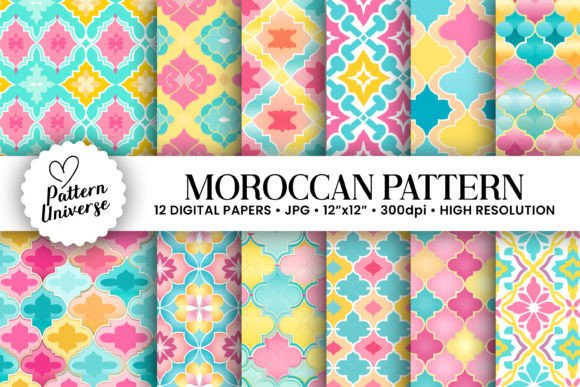
The intricate beauty of North African architecture has long captivated designers, but translating that physical artistry into digital formats requires specific technical considerations. Moroccan tiles seamless patterns are digital textures engineered to repeat infinitely without visible breaks or misaligned edges. Unlike a simple photograph of a tiled floor, these assets are mathematically adjusted so that the left edge perfectly matches the right, and the top aligns flawlessly with the bottom. This continuity allows creators to apply authentic Zellige or Bejmat aesthetics to surfaces of any size, from a small business card to a massive website hero banner, without the design looking disjointed or pixelated.
For professionals and hobbyists alike, the value lies in versatility. Authentic Moroccan tilework is renowned for its geometric precision, vibrant color palettes, and organic imperfections. A high-quality seamless pattern captures this duality. It provides the structured repetition necessary for digital backgrounds while retaining the handcrafted warmth that makes the style so appealing. Whether you are a web designer seeking a culturally rich backdrop, a print-on-demand entrepreneur creating stationery, or an educator designing engaging presentation slides, these patterns offer an immediate elevation in visual quality without requiring you to illustrate complex geometry from scratch.
Why Seamless Repetition Matters in Digital Design
Understanding the "seamless" aspect is crucial for anyone new to working with surface patterns. When a texture is not properly tiled, applying it to a large canvas results in obvious grid lines where the image repeats. This breaks immersion and makes the design look amateurish. True Moroccan tiles seamless patterns solve this by ensuring that motifs crossing the boundary wrap around correctly. For example, if a star shape is cut off on the right side of the tile, the remaining portion must appear at the exact corresponding position on the left side.
This technical precision supports several practical goals:
- Scalability: You can resize your project dimensions freely without worrying about running out of texture or revealing edges.
- Efficiency: Instead of manually placing individual tile graphics, you apply a single pattern fill, saving hours of layout work.
- Consistency: The visual rhythm remains uniform across different media, which is essential for brand identity and cohesive storytelling.
- File Optimization: Using a small, repeating tile is significantly lighter on bandwidth than using a massive, unique high-resolution image for a background.
Creative Applications Across Industries
The appeal of these patterns extends far beyond traditional interior design mockups. In the digital space, they serve as powerful tools for establishing atmosphere and cultural context. Web designers often use subtle, low-opacity Moroccan patterns as overlay textures to add depth to flat colors. This technique prevents minimalist websites from feeling sterile while maintaining excellent text readability. For e-commerce sellers, particularly those in the bohemian or artisanal niche, packaging design featuring seamless Zellige motifs can enhance the unboxing experience and reinforce product authenticity.
Educators and content creators also find immense utility in these assets. A history teacher discussing Islamic art or trade routes can use accurate tile patterns as slide backgrounds to visually anchor the lesson. Similarly, travel bloggers and influencers use them to frame quotes or create Pinterest pins that instantly signal a destination's aesthetic. The key is adaptation; the same pattern file can be recolored to match a corporate brand palette or kept in traditional cobalt and terracotta for historical accuracy. This flexibility makes Moroccan tiles seamless patterns a staple in diverse creative libraries.
Selecting the Right Pattern for Your Project
Not all seamless patterns are created equal, and choosing the wrong one can lead to frustration. Before downloading or purchasing, consider the intended application. Patterns designed for print require high resolution (usually 300 DPI) and CMYK color profiles to ensure crisp lines and accurate ink reproduction. Conversely, patterns optimized for web use should be RGB and compressed to maintain fast load times. Always check the license terms as well; some assets allow for personal use only, while others permit commercial application in products for resale.
Visual complexity is another critical factor. Highly detailed, dense mosaics can become visually noisy when scaled down or used behind text. If your goal is to provide a background for content, look for patterns with ample negative space or softer contrast. Bold, high-contrast geometric designs work best as focal points, borders, or standalone art prints. Beginners should start with simpler four-fold or eight-fold symmetry patterns before experimenting with complex sixteen-fold stars, as simpler geometries are more forgiving when adjusting scale or applying color overlays.
Navigating Cultural Authenticity and Style
While the aesthetic of Moroccan tilework is universally admired, it is rooted in centuries of mathematical and spiritual tradition. Approaching these designs with respect enhances both the quality of your work and your connection to the audience. Genuine Zellige involves cutting individual clay tiles to fit precise geometric tessellations. When selecting digital assets, prioritize those created by artists who understand these underlying rules rather than generic "oriental" clip art. Authentic patterns follow strict rotational symmetry and avoid representational imagery, adhering to traditional aniconism.
Using culturally accurate Moroccan tiles seamless patterns also helps avoid clichés. Instead of relying on stereotypical desert tropes, focus on the architectural sophistication of the tilework itself. This nuance resonates with knowledgeable audiences and adds a layer of professionalism to your output. Many modern designers are now blending traditional motifs with contemporary colorways—think sage greens, dusty pinks, or monochromatic scales—to bridge heritage and modern trends. This fusion allows the pattern to feel fresh and relevant in current design landscapes without losing its foundational integrity.
Practical Tips for Implementation
Once you have selected the appropriate asset, proper implementation ensures the best results. Always test your pattern at the actual output size before finalizing a design. What looks balanced on a 15-inch monitor might appear overwhelmingly large or microscopically small when printed on a postcard. Most design software allows you to adjust pattern scale independently of the object size; use this feature to fine-tune the density of the motif relative to other elements.
Color adjustment is equally important. Rarely does a stock pattern match your specific project palette perfectly out of the box. Utilize hue/saturation layers, gradient maps, or blend modes to integrate the pattern seamlessly into your composition. For instance, setting a pattern layer to "Multiply" or "Overlay" can allow underlying colors to show through, creating a more integrated and less pasted-on appearance. Remember that traditional Moroccan tiles have glaze variations and slight irregularities; preserving some of this texture in your digital adjustments maintains the organic charm that distinguishes this style from sterile vector graphics.
Finally, consider accessibility when using these patterns in digital interfaces. High-contrast geometric designs can sometimes trigger visual discomfort or interfere with screen readers if used improperly. Ensure sufficient contrast ratios between text and patterned backgrounds, and always provide solid color fallbacks for users who may have images disabled. By balancing aesthetic ambition with technical mindfulness, Moroccan tiles seamless patterns become more than just decoration—they become a functional, respectful, and enduring element of thoughtful design.