Evaluating Bodhi Leaves Silhouette Vectors for Design Projects
Selecting the right graphical assets is a critical step in ensuring the success of spiritual, wellness, or nature-themed design projects. Among the myriad of botanical options available to designers, the Bodhi leaves silhouette vector occupies a specific niche that bridges cultural symbolism and minimalist aesthetics. Understanding the functional attributes, symbolic weight, and technical considerations of this asset type is essential for making an informed selection. This evaluation explores when a Bodhi leaves silhouette vector serves as the optimal choice and when alternative visual strategies may better align with project goals.
Defining the Asset and Its Symbolic Weight
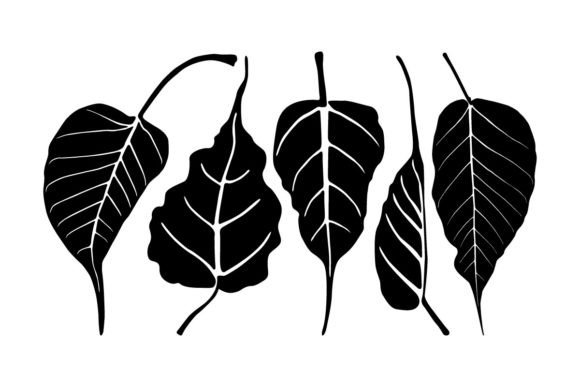
A Bodhi leaves silhouette vector is a digital graphic representation of the leaf from the Ficus religiosa, rendered as a solid shape without internal detail or texture. Unlike raster images, these vectors are defined by mathematical paths, allowing for infinite scaling without loss of quality. The defining characteristic of this specific asset is its distinct morphology: a heart-shaped base tapering into a long, slender drip tip. This shape is not merely botanical; it carries profound historical and religious significance in Buddhism, Hinduism, and Jainism as the tree under which Siddhartha Gautama attained enlightenment.
When evaluating this asset, one must recognize that it functions on two levels. Visually, it provides a clean, organic form suitable for modern minimalist design. Culturally, it acts as a semiotic shorthand for peace, awakening, and spiritual connection. For researchers and designers, the primary value proposition lies in this duality. The silhouette strips away the complexity of veins and color gradients, leaving only the pure essence of the form. This reduction makes it highly versatile for backgrounds, logos, and overlays, but it also places significant emphasis on the accuracy of the outline. A poorly proportioned silhouette loses both its botanical recognition and its symbolic integrity.
Strategic Benefits in Visual Communication
The decision to utilize a Bodhi leaves silhouette vector often stems from practical design requirements combined with thematic needs. One of the most significant benefits is scalability. Because the asset is vector-based, it can be resized from a small favicon to a massive billboard without pixelation. This makes it an efficient choice for cross-platform branding where consistency is paramount. Furthermore, the lack of internal detail ensures high legibility at small sizes, a common failure point for more intricate botanical illustrations.
From a compositional standpoint, silhouettes offer superior flexibility in layering. A solid Bodhi leaf can serve as a framing device, a mask for photography, or a subtle watermark. The negative space created by the leaf’s unique contour can be utilized to house text or secondary icons, maximizing spatial efficiency in layout design. Additionally, the monochromatic nature of a silhouette allows for effortless color adaptation. Designers can adjust the fill color to match any brand palette instantly, eliminating the need for complex color grading or retouching required by photographic assets.
Tradeoffs and Limitations to Consider
Despite their utility, Bodhi leaves silhouette vectors present specific tradeoffs that must be weighed during the selection process. The primary limitation is the absence of naturalistic detail. If the project goal is educational, scientific, or requires conveying the lushness of nature, a flat silhouette will likely feel sterile or insufficient. It communicates the idea of a leaf rather than the biological reality. In contexts where texture and depth are necessary to evoke emotion, this asset type may fall short.
Another consideration is the risk of genericization. Due to the popularity of spiritual and wellness aesthetics, low-quality or inaccurate Bodhi leaf vectors saturate stock marketplaces. Selecting a generic asset can inadvertently make a project appear derivative or unprofessional. There is also the matter of cultural sensitivity. Because the Bodhi leaf is a sacred symbol, using it purely as decorative filler in unrelated commercial contexts can be perceived as disrespectful or appropriative. Evaluators must assess whether the usage honors the symbol’s origin or merely exploits its aesthetic trendiness. Finally, while vectors are editable, modifying the fundamental curve of a Bodhi leaf to fit a specific layout requires bezier curve proficiency; improper editing can distort the recognizable drip tip, rendering the shape unidentifiable.
Ideal Use Cases and Strong Fits
Certain scenarios present a strong alignment between project needs and the capabilities of a Bodhi leaves silhouette vector. These assets excel in identity design for meditation centers, yoga studios, tea brands, and holistic health practitioners. In these contexts, the immediate recognition of the shape reinforces brand values without requiring textual explanation. They are equally effective in environmental graphics and wayfinding systems within retreat spaces, where simple, universal iconography is necessary for clarity and tranquility.
Print production offers another area of strong fit. Techniques such as laser cutting, vinyl plotting, and screen printing rely on clean, continuous paths. A Bodhi leaves silhouette vector is natively compatible with these manufacturing processes, whereas raster images would require tedious tracing and cleanup. Digital interfaces also benefit from this asset type; as UI elements or loading animations, the simple geometry renders quickly and remains crisp on high-density displays. When the objective is to convey serenity through minimalism, or when technical constraints demand scalable, single-color graphics, this vector format is often the superior solution.
When to Explore Alternatives
Evaluators should consider alternatives when the communication goals extend beyond symbolic minimalism. If the target audience requires botanical accuracy for identification purposes, a detailed line drawing or watercolor illustration is more appropriate. Similarly, if the design aims to evoke sensory experiences—such as the rustle of leaves or the play of light through foliage—photography or textured digital painting will outperform a flat vector. The silhouette cannot convey atmosphere; it can only convey form.
Alternatives are also worth considering when the specific cultural association of the Bodhi leaf is irrelevant or potentially confusing. If the theme is general nature appreciation rather than Eastern spirituality, a maple, oak, or eucalyptus silhouette might avoid unintended religious connotations while still providing organic shapes. Furthermore, if the project demands a unique, proprietary look, relying on stock vectors may be inadequate. Commissioning a custom illustration or generating a unique shape through procedural design tools ensures exclusivity that pre-made assets cannot provide. The decision ultimately hinges on whether the specific intersection of scalability, minimalism, and spiritual symbolism matches the project's core requirements.
Making the Final Selection Decision
Determining whether a Bodhi leaves silhouette vector aligns with your goals requires a structured evaluation of both technical specs and contextual fit. Begin by verifying the anatomical accuracy of the vector; the midrib should be straight, and the drip tip should be elongated and tapered, not stubby. Check the node structure of the file to ensure it is optimized for your intended output method; excessive anchor points can cause issues in cutting machines, while too few can result in jagged curves. Review the licensing terms rigorously, particularly regarding trademark use in logos, as many stock licenses prohibit trademarking unaltered assets.
Beyond technicalities, conduct a contextual audit. Ask whether the symbol adds meaningful value to the narrative or merely fills space. Consider the audience’s cultural literacy and potential sensitivities. If the asset passes both technical and ethical evaluations, it serves as a powerful, efficient tool for visual communication. However, if doubts persist regarding relevance or quality, the prudent course is to explore other botanical forms or commission bespoke artwork. The right choice is rarely about the asset itself, but about how precisely it resolves the specific tension between aesthetic desire and communicative function in your unique project landscape.